
Before any friendly match, agree on match duration, substitution rules, offside enforcement, and match ball provision with the opposing team manager—confirming these details at least 24 hours in advance prevents confusion and ensures both teams have a positive experience.
Why Pre-Match Agreements Matter
Friendly matches offer flexibility that league games don't—but that flexibility requires clear communication. Without agreed rules, teams can arrive with different expectations about everything from match length to substitution limits.
A quick conversation before match day prevents:
- Mid-game disagreements that disrupt play
- Player frustration when expectations differ
- Damage to relationships with potential regular opponents
- Awkward situations that could have been easily avoided
Taking five minutes to confirm the basics makes the entire experience smoother for everyone.
Essential Rules to Agree Before Every Friendly
1. Match Duration
Standard options for friendly matches:
| Format | Total Time | Common Usage |
|---|---|---|
| Full match | 2 x 45 minutes | Adult competitive teams |
| Reduced | 2 x 40 minutes | Preseason, limited fitness |
| Shortened | 2 x 35 minutes | Veterans, scheduling constraints |
| Three periods | 3 x 30 minutes | Squad rotation, player development |
| Youth formats | Varies by age | FA guidelines apply |
Agree on: Total match length, half-time duration (typically 10-15 minutes), whether you'll play added time, and flexibility if running late.
2. Substitution Rules
Friendlies typically allow more flexibility than competitive matches:
Rolling Substitutions
Players can leave and re-enter multiple times:
- Common in youth football and development-focused matches
- Maximizes playing time for all squad members
- Requires clear communication with opponent when swapping
Unlimited Substitutes with Set Windows
Change as many players as needed, but only at designated breaks:
- Matches competition-style rhythm
- Reduces disruption to play
- Good for tactical practice
Competition Rules
Follow league substitution limits:
- Useful for preseason match simulation
- Prepares players for competitive fixtures
- Typically 3-5 substitutes allowed
Discuss: How many substitutes each team can use, whether rolling subs are permitted, re-entry rules (once subbed, can they return?), and how to signal substitutions during play.
3. Offside Rule
Options for friendly matches:
- Full offside: Standard enforcement throughout
- No offside: Opens up play, useful for training attacking movement
- Modified zones: Offside only in final third, or build-up areas exempt
Most adult friendlies play with full offside rules. Youth matches may modify based on development objectives.
4. Officiating Arrangements
Self-Refereed
Both teams make calls collaboratively:
- Common for informal friendlies
- Requires mature, sporting attitude from players
- Designate team captains as decision-makers for disputes
Single Referee
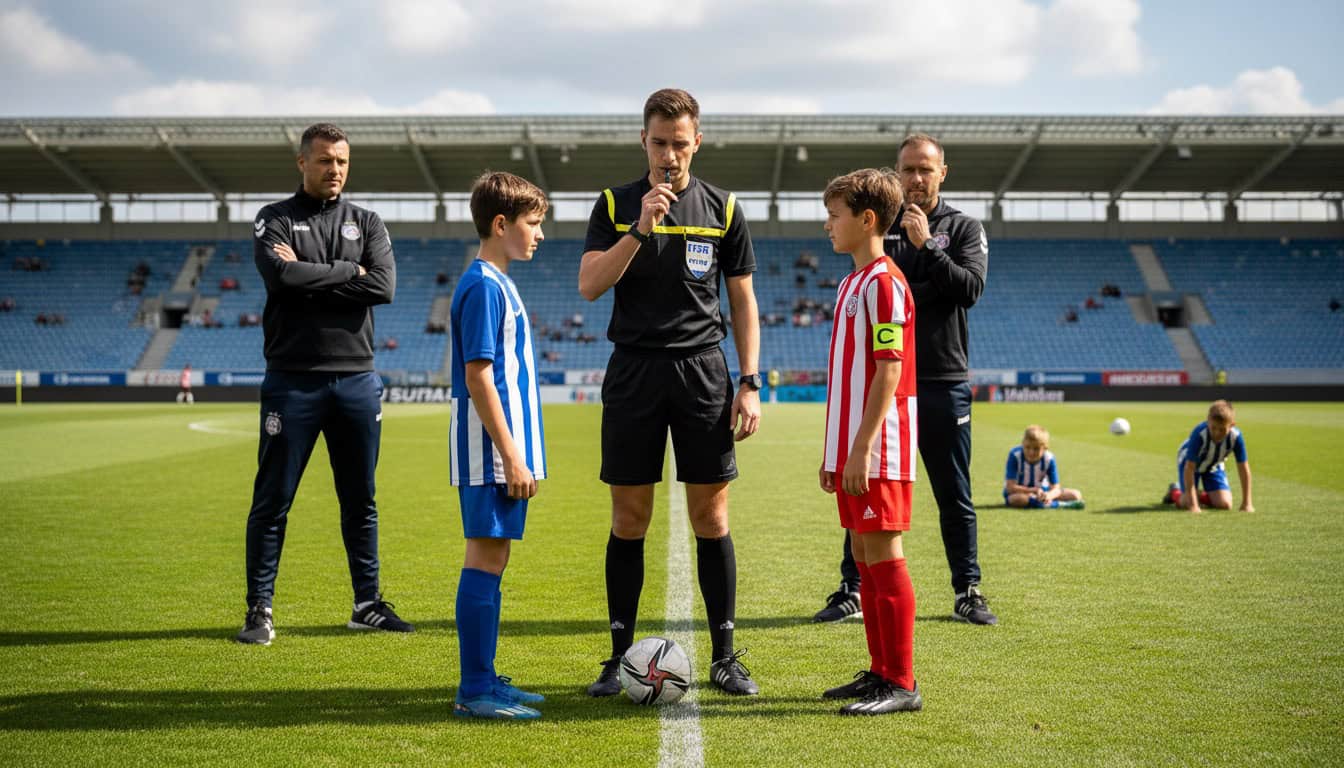
One official manages the match:
- Better flow and consistency
- May be provided by home team or split cost
- Clarify who arranges and pays
Full Officials
Referee plus assistant referees:
- Mirrors competitive match conditions
- Higher cost, advance booking required
- Useful for preseason preparation
5. Match Ball and Equipment
Clarify who provides:
- Match ball: Usually home team, but confirm
- Bibs or alternative kit: If colours clash
- Corner flags and goals: Standard at most venues
- First aid kit: Both teams should carry basics
Additional Rules Worth Discussing
Card Policy
For friendlies, agree how you'll handle cautions and dismissals:
- Recording cards: Will you track them for squad discipline purposes?
- Sin bin option: Temporary 10-minute exclusion instead of red card
- Serious foul play: Immediate removal regardless of friendly status
Injury Time and Breaks
Clarify expectations for:
- Whether you'll add time for injuries and stoppages
- Who tracks time for self-refereed games
- Hard finish time due to venue bookings
- Scheduled water breaks, especially in warm weather
Playing Conditions
Discuss thresholds for postponement or match modifications:
- Weather: Heavy rain, lightning, frozen pitch
- Pitch quality: Waterlogged areas, dangerous surfaces
- Lighting: If match runs into dusk
Pre-Match Checklist Template
Send this to your opponent 24-48 hours before the match:
Friendly Match Confirmation Template
FRIENDLY MATCH CONFIRMATION
Date: [Date]
Kick-off: [Time]
Venue: [Location + postcode]
MATCH FORMAT
- - Duration: [2 x __ minutes]
- - Half-time: [__ minutes]
- - Substitutions: [Rolling / Unlimited / Competition rules]
- - Offside: [Yes / No / Modified]
- - Referee: [Self-refereed / Provided by __]
LOGISTICS
- - Match ball provided by: [Home / Visitor]
- - Changing rooms: [Available / Not available]
- - Parking: [Details]
CONTACT ON THE DAY
Name: [Manager name]
Phone: [Number]
Please confirm these details or let me know if you'd like to discuss any changes.
Age Group Considerations
Youth Football
Additional agreements for youth matches:
- FA youth format rules: Retreat line, build-out line for younger ages
- Playing time: Commitment to equal opportunities
- Heading restrictions: Follow current guidelines
- Parent spectator zones: Where adults should stand
- Coaching from touchline: Agreed approach to sideline instructions
Veterans and Walking Football
Modified rules common in over-35s and walking formats:
- No running: Walking football rules if applicable
- Reduced contact: Agreement on tackling intensity
- Three-touch or pass limits: If using modified formats
- Rolling subs: Almost always standard
Ready to find matches?
Join verified teams finding friendly matches in minutes, not days.
Handling Mid-Match Disputes
If disagreement arises during play because rules weren't fully agreed:
Pause Play Safely
Wait for a natural stoppage before discussing
Captains Confer
Designated leaders from each team discuss the issue
Find Compromise
Meet in the middle where possible
Apply Sporting Spirit
When in doubt, give the benefit to your opponent
Note for Next Time
Record what should be clarified for future fixtures
The goal is completing the match positively—winning an argument but souring the relationship achieves little.
Sample Pre-Match Conversation
Here's how a typical rule discussion might go via message:
You
"Hi, looking forward to Saturday. Can we confirm: 2x40 minute halves, rolling subs, full offside, self-refereed? We'll provide the match ball. Work for you?"
Opponent
"Sounds good. Can we do 2x35 instead? We're carrying a few knocks and want to manage minutes. Happy with everything else."
You
"No problem, 2x35 it is. See you at 10am for 10:30 kick-off."
Simple, clear, sorted.
How This Relates to Other Topics
Frequently Asked Questions
What if we forget to agree rules beforehand?
Have a quick conversation with the opposing manager before warm-ups begin. Five minutes of discussion prevents 80 minutes of confusion.
Should friendlies always use rolling substitutions?
Rolling subs maximize playing time, especially valuable for youth development and squad depth testing. However, if you're simulating competitive conditions, stick to match-day rules.
Do we need a referee for friendlies?
Not necessarily. Many friendlies are self-refereed successfully when both teams approach the game with sporting attitudes. Consider a referee for heated local rivalries or development of match-day habits.
What if the other team wants different rules than us?
Find middle ground. If they want 2x45 and you want 2x35, suggest 2x40. Flexibility is the spirit of friendly football—the match matters more than winning the negotiation.
How do we handle it if a player gets sent off in a friendly?
Agree beforehand. Options include: player leaves for 10 minutes (sin bin), player is substituted and can't return, or player leaves completely. Most friendlies use a sin bin approach.
Should youth friendlies use full-size goals and pitches?
Follow FA guidelines for age-appropriate formats. Younger age groups use smaller pitches, goals, and balls to support development. Your opponent should be using the same standards.
What about injury liability in friendlies?
Ensure your club has appropriate insurance coverage. Friendly matches should be covered under standard club policies, but verify before the season begins.
Can we change agreed rules during the match if both managers consent?
Yes, if both teams agree mid-match (e.g., shortening the second half due to fading light), that's fine. Communicate the change to all players.
How formal should the rule agreement be?
A text message confirmation is usually sufficient. For development matches or academy fixtures, some clubs use formal match agreement forms.
What if the opponent has never played a friendly before?
Walk them through the standard options and recommend typical rules. They'll appreciate the guidance, and you'll establish a good working relationship.