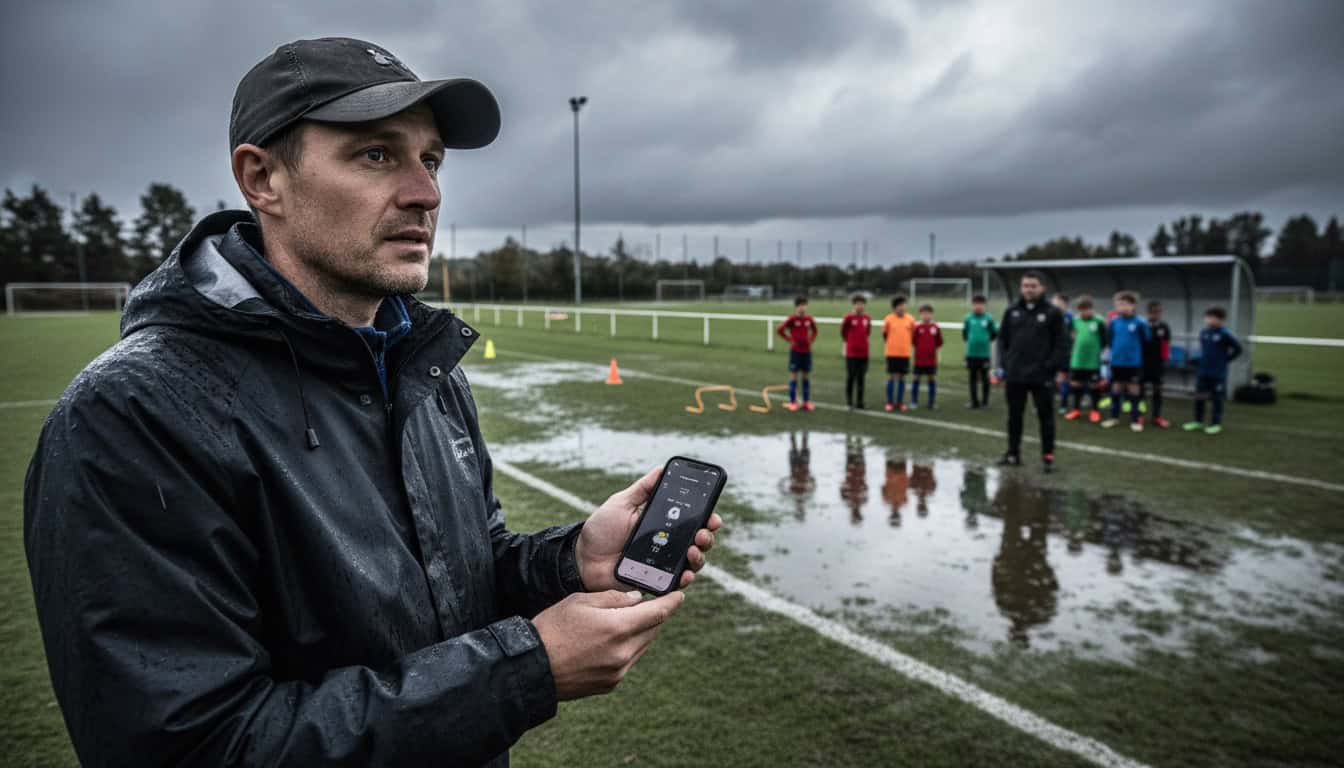
Create weather contingency plans by agreeing postponement criteria with opponents in advance, identifying backup venues (especially 3G pitches), and establishing clear communication protocols—so when bad weather hits, you can make quick decisions that protect players and preserve relationships.
Why Weather Planning Matters for Friendlies
League matches have official pitch inspections and governing body decisions. Friendlies don't—the decision rests with you and your opponent. Without agreed plans, bad weather creates confusion, wasted journeys, and strained relationships.
Benefits of Good Weather Contingency Planning
British weather is unpredictable. Plan for it.
Weather Conditions That Affect Outdoor Matches
Heavy Rain
Impact on grass pitches:
- Waterlogged areas create injury risk
- Ball won't roll, affecting play quality
- Surface becomes churned and dangerous
- Damage to pitch affects future users
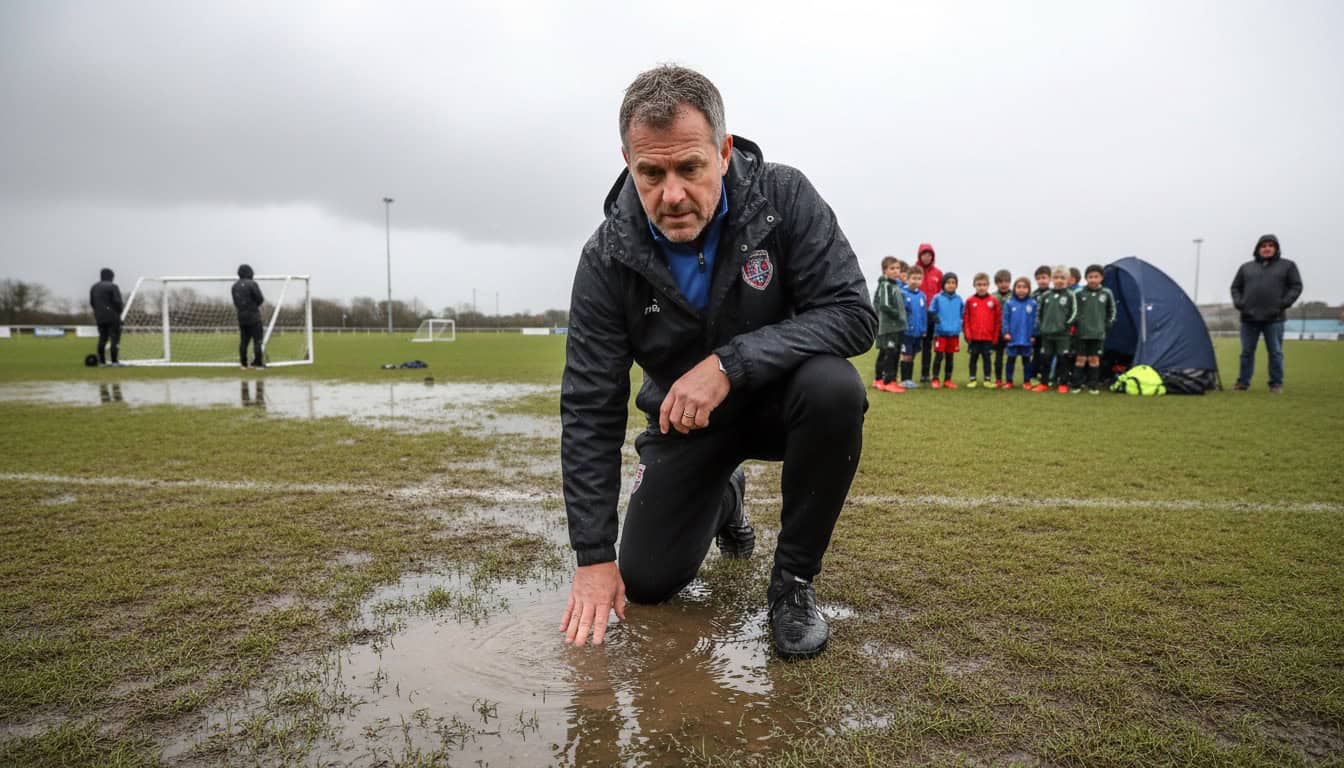
Decision factors: How long has it been raining? What's the forecast for match time? How well does the pitch drain? Is standing water visible?
Frost and Frozen Ground
Impact:
- Hard surface increases impact injuries
- Unpredictable ball bounce
- Sliding tackles become dangerous
- Frozen ruts and divots hidden under frost
Decision factors: Overnight and morning temperatures, sun exposure on the pitch, sheltered vs exposed areas, forecast for temperature rise.
Snow
Impact:
- Line markings invisible
- Ball behavior unpredictable
- Cold-related injury risk
- Travel disruption likely
High Winds
Impact:
- Goal posts may become unstable
- Ball flight unpredictable
- Flying debris risk
- Temporary structures (tents, barriers) unsafe
Extreme Heat
Impact:
- Heat exhaustion and dehydration risk
- Reduced performance capacity
- Sunburn for extended exposure
- Surface temperature on artificial pitches
Lightning Safety
If lightning is visible or thunder audible, stop play immediately. Clear the pitch and seek shelter. Wait 30 minutes after last lightning/thunder before resuming. No exceptions—safety is absolute.
Creating Your Contingency Plan
Step 1: Agree Criteria with Opponents
Before match day, confirm:
Postponement Triggers
- "If the pitch is waterlogged, we'll postpone"
- "If frost hasn't cleared by 10am, we'll call it off"
- "If Met Office issues weather warnings, we'll reassess"
Decision Timeline
- "We'll make a call by 8am on match day"
- "I'll check the pitch at 9am and message you"
- "Let's both check forecasts on Friday evening"
Decision Maker
- Home team usually has final say on pitch condition
- Both managers should agree on the decision
- Don't force play if either side has serious concerns
Step 2: Identify Backup Options
3G/4G artificial pitches:
- All-weather surfaces that drain instantly
- Usually available for short-notice booking
- May cost more than grass hire
- Contact local facilities for availability
Indoor options:
- Sports halls for small-sided alternatives
- Reduced format better than no football
- Check ceiling height for realistic play
- Booking often required in advance
Alternative grass pitches: Some pitches drain better than others. Different venues in your area may be playable. Know which local pitches handle wet weather.
Rescheduling: Have backup dates in mind. Agree rescheduling approach in advance. Both teams should offer alternative dates.
Step 3: Establish Communication Protocol
Who contacts whom:
- Home team typically initiates contact
- Away team should check in if they haven't heard
- Exchange mobile numbers, not just email
When to communicate:
- Evening before: preliminary assessment
- Morning of match: pitch inspection result
- If conditions change: immediate update
What to say: Clear decision ("Match is ON" or "Match is OFF"), reason ("Pitch is waterlogged, standing water in goal areas"), and next steps ("Let's reschedule for [date]" or "Backup venue booked").
Match Day Weather Decisions
Morning of the Match
If you're the home team:
- Check the forecast one more time
- Inspect the pitch in person if possible
- Make a decision by agreed time
- Contact opponent immediately
- Update any officials or venue staff
If you're the away team:
- Check the forecast for the area
- Wait for home team communication
- If you haven't heard by agreed time, reach out
- Don't travel until you have confirmation
- Be ready to adjust plans quickly
| Condition | Likely Decision | Notes |
|---|---|---|
| Light rain, good drainage | Play | Monitor during match |
| Heavy rain overnight, still falling | Postpone | Pitch will worsen |
| Heavy rain stopped, forecast dry | Inspect | May be playable by kick-off |
| Hard frost, sun on pitch | Wait | May thaw by midday |
| Hard frost, overcast | Postpone | Won't improve |
| Snow on ground | Postpone | Unless minimal and clearing |
| High wind warning | Assess | Depends on venue exposure |
| Extreme heat warning | Modify | Earlier kick-off, drink breaks |
| Lightning | Stop/Postpone | Non-negotiable |
When You're Unsure
If conditions are borderline:
- Err on the side of caution — Player safety comes first
- Consider the journey — Don't ask teams to travel for a likely cancellation
- Think about the pitch — Damage to playing surfaces affects everyone
- Respect concerns — If either team has reservations, postpone
Communicating Weather Decisions
Postponement Message Template
"Hi [Name],
Unfortunately, we need to postpone today's match. The pitch is waterlogged with standing water in both penalty areas after overnight rain.
I've checked the forecast and conditions won't improve enough for a safe game today.
Can we reschedule? We're free on [dates]. Let me know what works for you.
Sorry for the disruption—hopefully we'll get better luck with the weather next time.
[Your name]"
Match Going Ahead Message
"Hi [Name],
Just checked the pitch—we're good to go for today. There was some rain overnight but the pitch drains well and it's drying out.
See you at [time] as planned.
[Your name]"
Backup Venue Message
"Hi [Name],
The grass pitch is unplayable today, but I've managed to book [Venue Name] 3G pitch for [time].
It's at [address/postcode]. Parking is [details]. Same match format as planned.
Let me know if this works for you—if not, we can reschedule to grass another time.
[Your name]"
Using Backup Venues Effectively
3G Pitches as Backup
Advantages:
- Play in almost any weather
- Consistent surface quality
- Often have floodlights for flexibility
- Professional appearance
Considerations:
- Cost may be higher than grass
- Some players prefer grass
- Footwear requirements (studs vs astro trainers)
- Availability may be limited at short notice
Booking tips: Build relationships with local 3G venues. Ask about short-notice availability policies. Consider block booking with cancellation options. Know their weather cancellation terms.
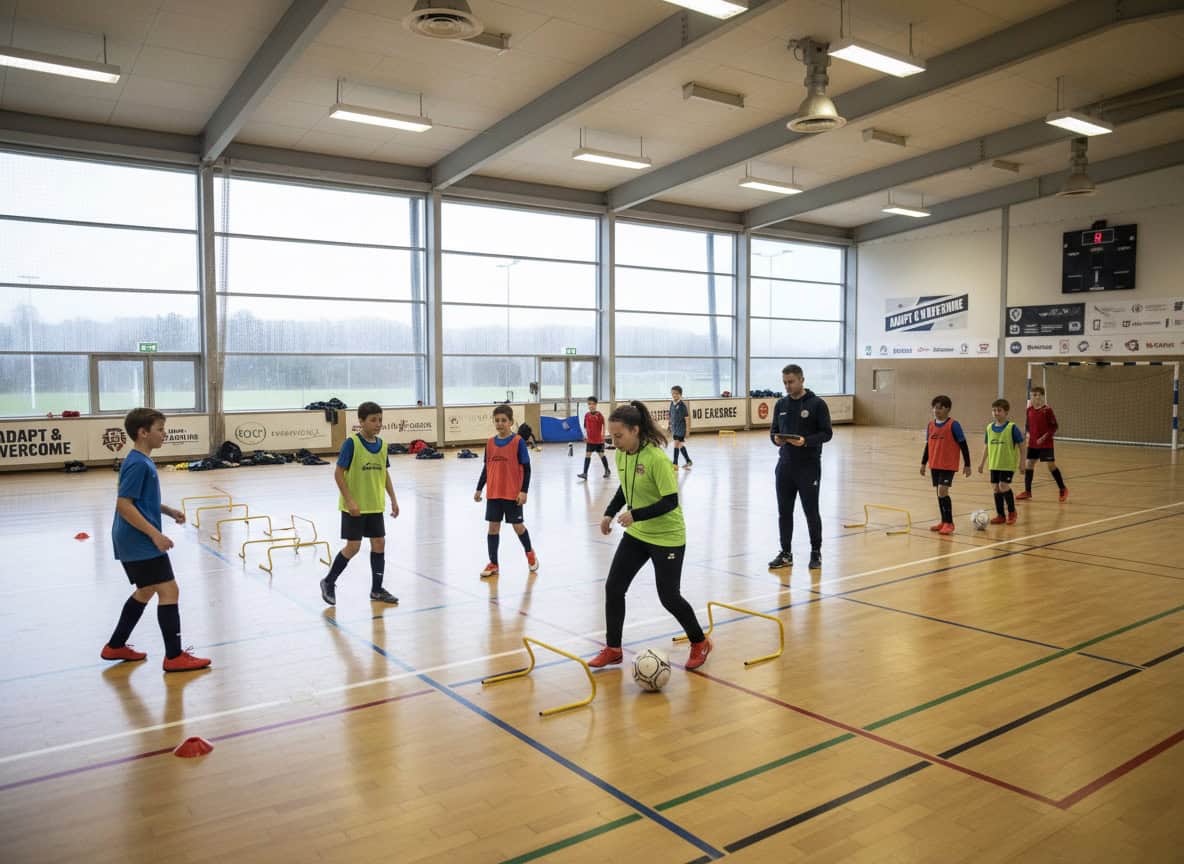
Indoor Alternatives
When outdoor play isn't possible:
- 5-a-side: Better than no football
- Futsal: Skills-focused alternative
- Sports hall: Check dimensions and floor type
- Training session: Convert to indoor skills work
Frame it positively: "We couldn't play the match, but we got a good session in."
Ready to find matches?
Join verified teams finding friendly matches in minutes, not days.
Seasonal Weather Planning
Autumn (Sep-Nov)
Rain, shortening daylight, early frost
- Book pitches with good drainage
- Schedule earlier kick-offs
- Have 3G backup venues identified
Winter (Dec-Feb)
Frost, frozen pitches, snow, short days
- Consider 3G as default
- Schedule midday kick-offs
- Accept some rescheduling needed
Spring (Mar-May)
Variable conditions, April showers, late frost
- Monitor forecasts closely
- Pitches recovering from winter
- Ideal for catching up postponed matches
Summer (Jun-Aug)
Extreme heat, hard ground, thunderstorms
- Schedule morning/evening kick-offs in heatwaves
- Plan drink breaks
- Watch for afternoon thunderstorms
Weather Resources for Match Planning
Forecasting Tools
- Met Office: Official UK forecasts, warnings, and hourly predictions
- BBC Weather: Accessible hourly and daily forecasts
- Weather apps: Many offer location-specific alerts
- Radar maps: See rain approaching in real-time
Pitch Assessment Checklist
- Visual inspection: Standing water, frozen ground, damage
- Walking test: Does the surface give way underfoot?
- Ball roll test: Does the ball move normally?
- Safety check: Any dangerous areas (divots, debris)?
How This Relates to Match Organization
Frequently Asked Questions
Who has the final say on postponing a friendly?
Typically the home team, as they can inspect the pitch. However, both managers should agree. If the away team has serious concerns about travel or conditions, their view should be respected.
How early should we make the decision to postpone?
As early as you can while still making an accurate call. For morning matches, decide by 7-8am. For afternoon matches, a mid-morning decision gives teams time to adjust plans.
Should we play on a waterlogged pitch if both teams agree?
Generally no. Waterlogged pitches damage the surface for future users, increase injury risk, and produce poor quality football. Find an alternative or reschedule.
What if the weather improves after we've postponed?
Sometimes this happens. Don't second-guess the decision—you made the right call with the information available. Note it for next time with that venue.
How do we handle costs if we book a backup 3G and then don't need it?
Discuss this when arranging backup. Some venues offer flexible cancellation. Otherwise, agree in advance how costs are shared if the booking isn't used.
Can we start a match and abandon it if weather worsens?
Yes, but try to avoid this situation. If conditions deteriorate significantly (lightning, dangerous wind), stop play immediately. Agree what constitutes an official result if abandoned.
What about youth matches in bad weather?
Apply stricter standards for youth football. Children are more vulnerable to cold and injury. If in doubt, postpone. Parents will appreciate caution over bravado.
How do we reschedule a postponed match?
Contact the opponent within 48 hours with alternative dates. Be flexible—both teams have been inconvenienced. Use platforms like Team Game Finder to find new slots quickly.
Should we have a rain date built into the original fixture?
It helps. When confirming a match, agree a backup date: Let's do March 15th, with March 22nd as backup if weather is bad. This speeds up rescheduling.
What if one team wants to play and the other doesn't?
The team with concerns shouldn't be forced to play. Discuss the specific issues. If you can't agree, postpone—playing reluctantly benefits no one.