Quick Answer
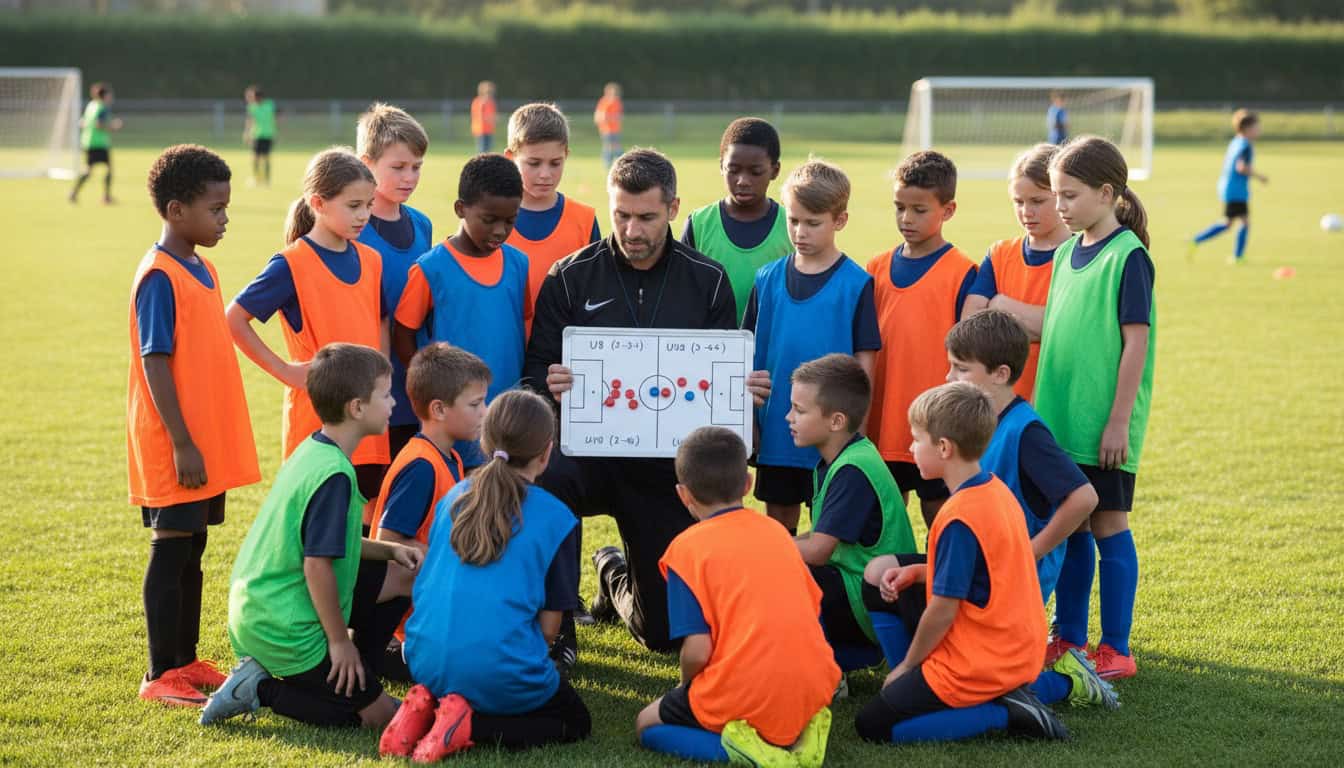
Youth age groups use "U" (Under) followed by an age number—U10 means players must be under 10 years old on a specific cutoff date. Each age group has tailored pitch sizes, match durations, squad sizes, and development focuses appropriate to that stage.
- ✓"U" means "Under" — U12 players must be under 12 on the governing body's cutoff date
- ✓Formats scale with age — Younger groups play smaller-sided games on smaller pitches
- ✓Development priorities shift — Focus moves from fun to skills to tactical understanding
How Youth Age Groups Work
The "Under" System
Youth football uses age categories identified by "U" followed by a number:
- U6 = Under 6 years old
- U10 = Under 10 years old
- U16 = Under 16 years old
A player's eligibility depends on their age on a cutoff date set by the governing body. Players who are still the specified age (or younger) on that date can play in that age group for the entire season.
Cutoff Dates
Cutoff dates vary by country and association:
| Region | Typical Cutoff Date |
|---|---|
| England (FA) | August 31 |
| Scotland (SFA) | February 28/29 |
| USA (US Soccer) | January 1 |
| UEFA competitions | January 1 |
| FIFA competitions | January 1 |
Playing Up and Playing Down
Playing up — Competing in an older age group than required. This is allowed in most associations with parental consent and is common for advanced players seeking greater challenge.
Playing down — Competing in a younger age group. This is generally not permitted in competitive football but may be allowed for players with additional needs with specific association approval.
Age Group Overview
Mini Soccer / Foundation Phase (U6-U8)
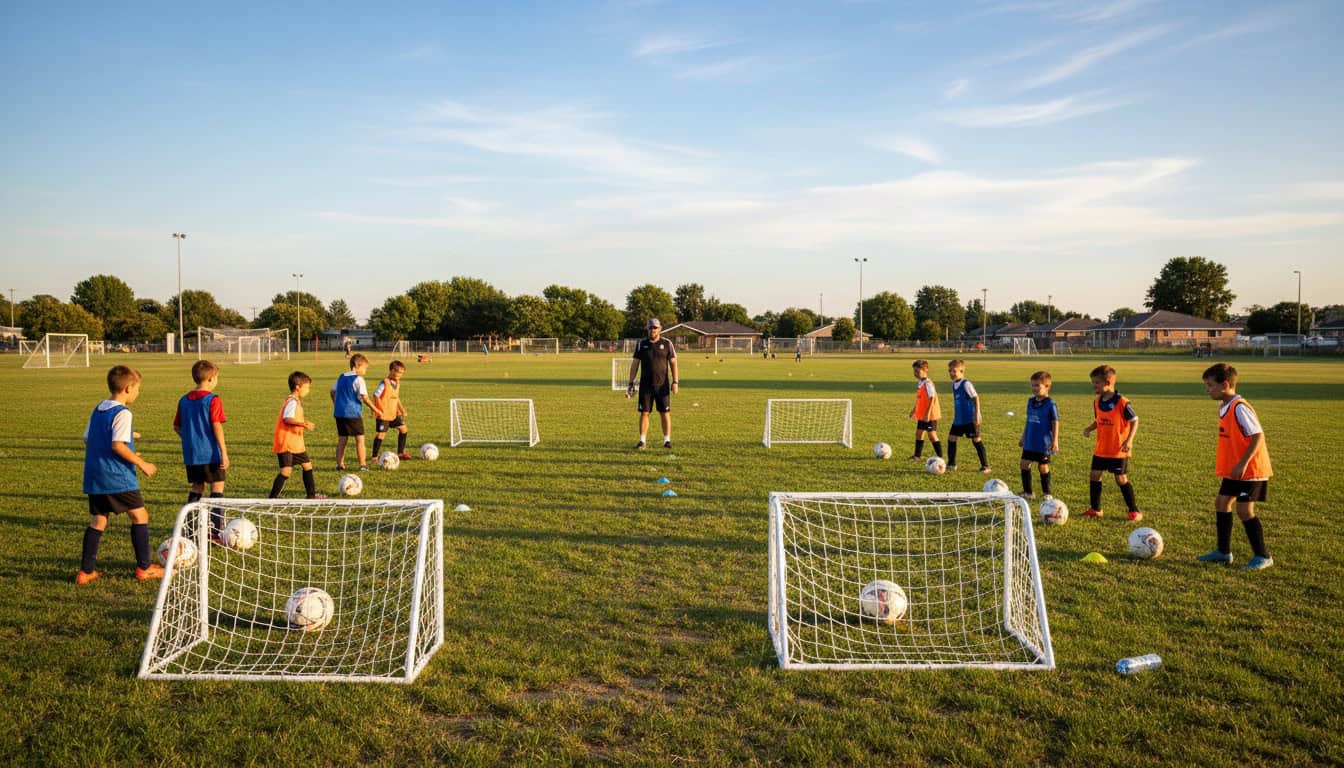
This introduction to football focuses on enjoyment, movement, and basic ball skills.
U6 (Under 6)
| Format | 3v3 or 4v4 (no goalkeepers) |
| Pitch size | 20-25m x 15-20m |
| Goal size | 3.6m x 1.2m (pop-up goals) |
| Ball size | Size 2 or 3 |
| Match duration | 4 x 6-minute quarters |
Development focus: Fun, basic movement, ball familiarity, social skills
U7-U8 (Under 7-8)
| Format | 5v5 (including goalkeeper) |
| Pitch size | 30-35m x 20-25m |
| Ball size | Size 3 |
| Match duration | 4 x 8-10 minute quarters |
Development focus: Basic techniques, 1v1 situations, spatial awareness, enjoyment
Youth Development Phase (U9-U12)
Players develop core techniques and begin understanding team concepts.
U9-U10 (Under 9-10)
| Format | 7v7 (including goalkeeper) |
| Pitch size | 55-60m x 35-40m |
| Goal size | 3.66m x 1.83m (12ft x 6ft) |
| Ball size | Size 4 |
| Match duration | 2 x 25-30 minute halves |
Development focus: Passing and receiving, shooting, defending basics, positional awareness
U11-U12 (Under 11-12)
| Format | 9v9 (including goalkeeper) |
| Pitch size | 70-75m x 45-50m |
| Goal size | 4.88m x 2.13m (16ft x 7ft) |
| Ball size | Size 4 |
| Match duration | 2 x 30-35 minute halves |
Development focus: Technical skills under pressure, team shape, decision-making, transitions
Foundation to Youth Transition (U13-U14)
The move to 11-a-side football on full-size pitches.
| Format | 11v11 |
| Pitch size | Full size (~90m x 55m) |
| Goal size | Full size (7.32m x 2.44m) |
| Ball size | Size 5 |
| Match duration | 2 x 35-40 minute halves |
Development focus: 11v11 principles, positional roles, physical development, mental resilience
Youth Phase (U15-U18)
Players refine their game and prepare for adult football. Match formats remain 11v11 on full-size pitches with durations increasing to full 90-minute matches by U17-U18.
Development focus: Tactical understanding, physical conditioning, position specialization, competitive mindset, leadership, and senior football preparation.
Senior Youth / Reserve Phase (U19-U23)
The bridge between youth and senior football. Many professional leagues operate U23 or reserve leagues allowing players under 23 plus a limited number of overage players.
Development focus: First-team readiness, competitive match sharpness, pathway visibility
Development Stages and Priorities
FUNdamental Stage (U6-U9)
Primary goal: Fall in love with the ball
Players at this stage have short attention spans and learn through play. Coaching focuses on games-based sessions with high ball contact time and positive reinforcement. Fun is the priority.
Skill Acquisition Stage (U10-U12)
Primary goal: Develop technical foundation
This is often called the "golden age" of skill learning. Players have improved coordination and are ready for technical detail. Coaching balances technical repetition with variety and introduces tactical concepts.
Game Understanding Stage (U13-U16)
Primary goal: Apply skills in game contexts
Players experience puberty and growth spurts while developing increased tactical awareness. Coaching focuses on game-realistic training, positional development, and mental skills introduction.
Performance Stage (U17+)
Primary goal: Refine and compete
Physical maturation completes and players make career pathway decisions. Coaching becomes position-specific with high-intensity training and competition preparation.
Matching Age Groups for Friendlies
Same Age Group Matches
Best for fair competition with similar physical development. However, within-age-group skill variation can be significant, and birth date effects affect development.
Mixed Age Group Matches
Playing older opposition: Can challenge advanced teams and test readiness for the next age group.
Playing younger opposition: Provides development matches for weaker squads and allows focus on specific skills.
Guidelines: Maximum one year difference recommended. Two-year gaps require careful consideration of physical and emotional readiness.
Physical Development Considerations
Growth and Maturation
Players in the same age group can be at very different stages physically:
- Early developers may dominate physically in younger ages but this advantage often reduces by U16-U18
- Late developers may struggle physically against peers but often develop superior technique to compensate
- Relative Age Effect: Players born early in the selection year are statistically over-represented at higher levels
Playing Time Guidelines
| Age Group | Recommended Max Weekly Match Minutes |
|---|---|
| U7-U8 | 40 minutes |
| U9-U10 | 60 minutes |
| U11-U12 | 70 minutes |
| U13-U14 | 80 minutes |
| U15-U16 | 90 minutes |
Registration and Eligibility
Typical registration requirements include birth certificate or passport for proof of age, photograph, medical information, and parental consent for players under 18.
Many associations allow dual registration—primary registration with main club and secondary registration for additional playing opportunities.