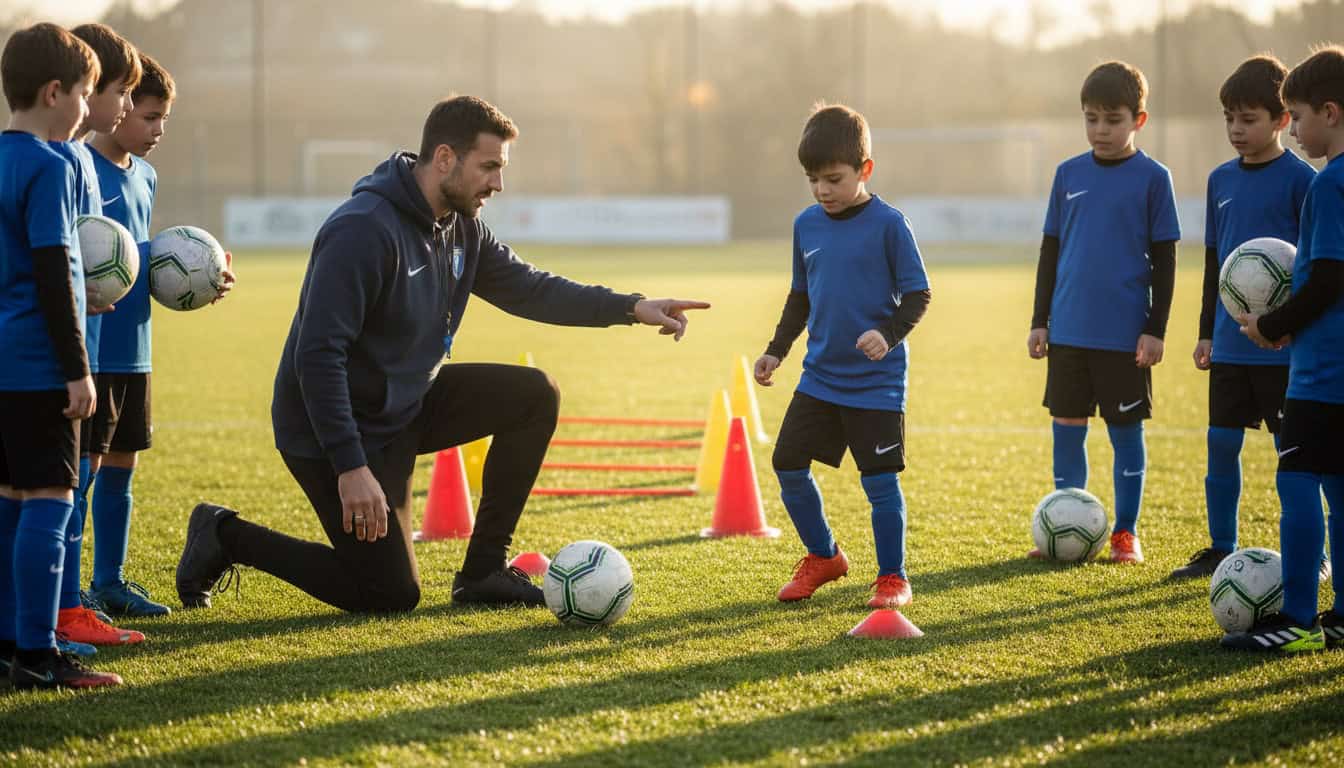
Quick Answer
Set up age-appropriate training by matching session length, content, and coaching style to each developmental stage—focusing on fun and movement for U6-U8s, technical skills for U9-U11s, tactical understanding for U12-U14s, and performance refinement for U15+.
- ✓Match the stage — Different ages need different approaches to training
- ✓Adjust session structure — Shorter sessions for younger players, more complexity for older
- ✓Prioritize appropriately — Fun first for young children, skills then tactics as they develop
Why Age-Appropriate Training Matters
Children aren't small adults. Their physical, cognitive, and emotional development follows predictable stages that should shape how we train them.
Age-appropriate training:
- Maximizes development: Working with developmental windows, not against them
- Maintains engagement: Sessions that feel right keep players coming back
- Prevents burnout: Appropriate demands avoid physical and mental overload
- Builds foundations: Each stage prepares for the next
Training a U7 like a U15 doesn't accelerate development—it frustrates children and often drives them away from football.
Developmental Stages Overview
| Stage | Ages | Primary Focus | Key Characteristics |
|---|---|---|---|
| Foundation | U6-U8 | Fun, movement, ball familiarity | Short attention span, loves play |
| Skill Acquisition | U9-U11 | Technical development | Learning quickly, competitive |
| Game Understanding | U12-U14 | Tactical awareness | Abstract thinking, peer-focused |
| Performance | U15-U18 | Refinement, physical development | Adult-like capacity, specialization |
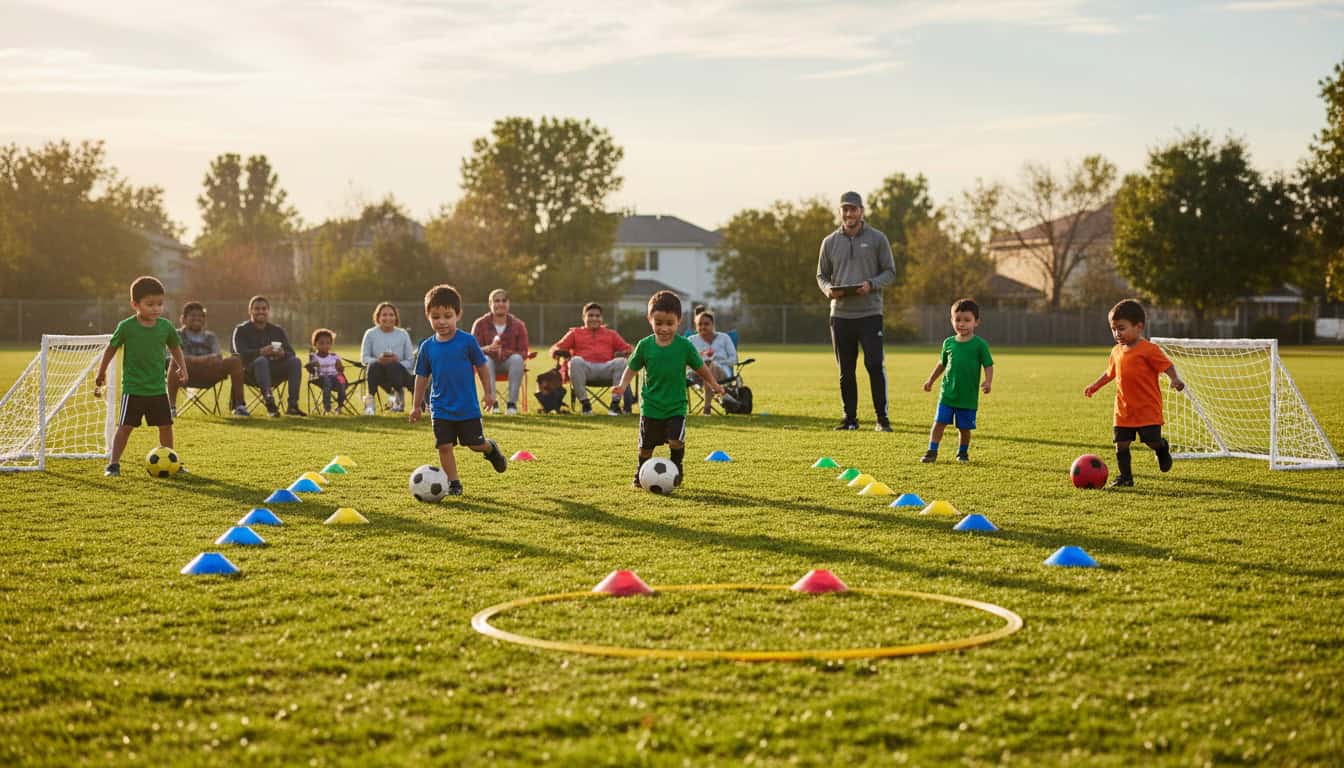
Foundation Stage (U6-U8)
Player Characteristics
At this age, children have attention spans of 5-10 minutes, are naturally egocentric (the ball is "mine"), learn through play and exploration, and need constant activity and variety.
Training Session Structure
Duration: 45-60 minutes maximum
| Segment | Duration | Focus |
|---|---|---|
| Arrival activity | 5-10 min | Free play with balls |
| Warm-up game | 5-8 min | Movement with fun theme |
| Core activity 1 | 8-10 min | Ball familiarity |
| Core activity 2 | 8-10 min | Simple game/challenge |
| Small-sided game | 15-20 min | 3v3 or 4v4 |
| Cool-down | 5 min | Gentle activity, celebration |
What to Include
Movement fundamentals: Running, stopping, changing direction, jumping, hopping, balancing, coordination challenges.
Ball familiarity: Touching the ball often, dribbling in spaces, simple passing and receiving, shooting at goals.
What NOT to include: Complex tactical instruction, position-specific coaching, lengthy explanations, or standing in lines waiting.
Coaching Approach
- Enthusiastic and positive: Energy matters
- Demonstrate don't lecture: Show, don't tell
- Use imagery and themes: "Dribble like a lion hunting"
- Praise effort: Celebrate trying
- Keep everyone moving: Minimize standing still
- Make it fun: If they're not smiling, adjust
Skill Acquisition Stage (U9-U11)
Player Characteristics
At this age, children have longer attention spans (15-20 minutes), are in the "golden age of learning" where skills stick easily, enjoy competition and comparison, and can follow more complex instructions.
Training Session Structure
Duration: 60-75 minutes
| Segment | Duration | Focus |
|---|---|---|
| Warm-up | 10 min | Dynamic movement with ball |
| Technical block 1 | 15 min | Core skill development |
| Technical block 2 | 12 min | Skill in game context |
| Small-sided game | 20-25 min | 5v5, 6v6, or 7v7 |
| Cool-down | 5-8 min | Stretching, review |
Technical Priorities
- Passing accuracy and weight
- Receiving and first touch
- Dribbling with purpose
- Shooting technique
- Heading introduction (U11)
Game Understanding Stage (U12-U14)
Player Characteristics
At this age, young people can think abstractly about tactics, experience physical changes (growth spurts), are heavily influenced by peers, and can concentrate for longer periods.
Training Session Structure
Duration: 75-90 minutes
| Segment | Duration | Focus |
|---|---|---|
| Warm-up | 10-12 min | Football-specific activation |
| Technical/tactical block | 20 min | Focused skill or tactical work |
| Functional practice | 15-20 min | Position-specific or unit work |
| Game | 25-30 min | Conditioned or full game |
| Cool-down | 8-10 min | Recovery, reflection |
Coaching Approach
- Involve players in learning: They want ownership
- Explain the "why": Reasoning helps buy-in
- Use video and examples: Visual learning effective
- Manage physical differences: Growth varies hugely
- Be patient with adolescence: Mood swings are normal
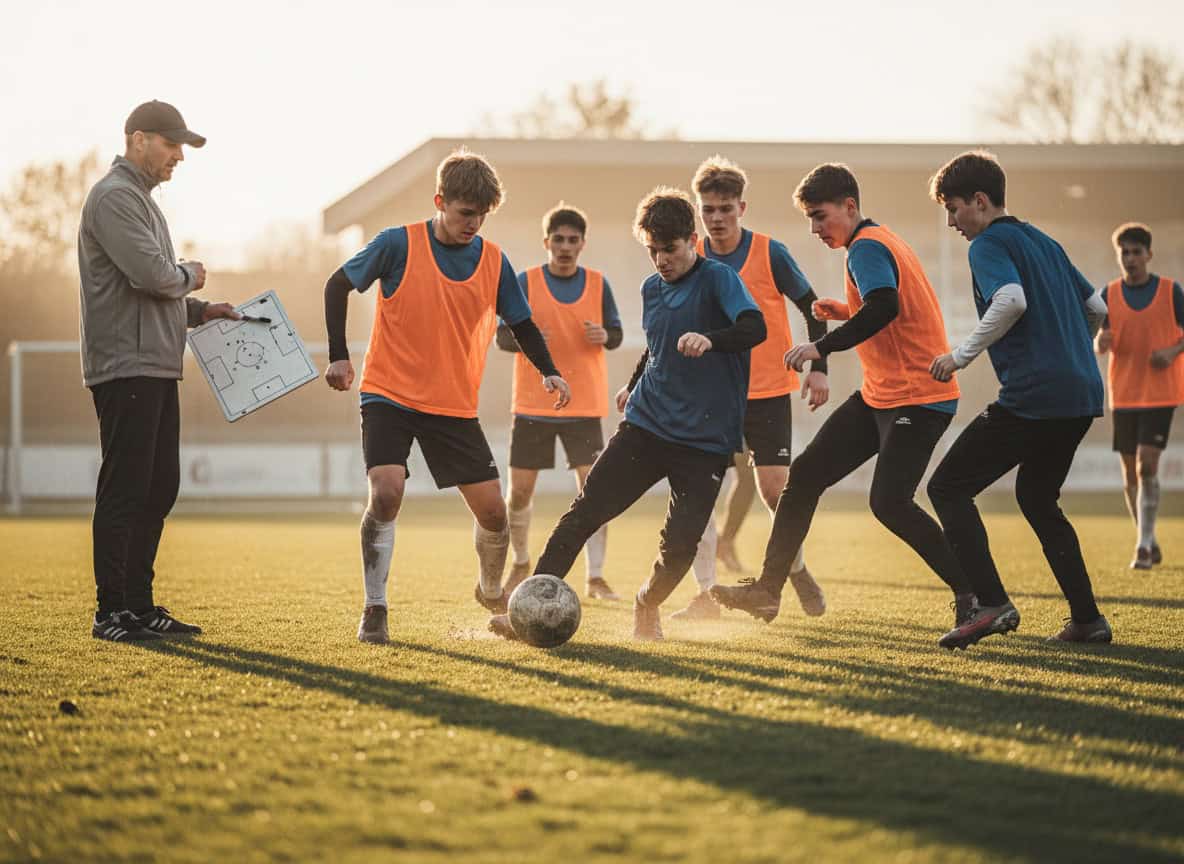
Performance Stage (U15-U18)
Player Characteristics
At this age, players have near-adult physical capacity, can handle complex tactical information, are thinking about football pathways, and benefit from responsibility and leadership.
Training Session Structure
Duration: 90 minutes
| Segment | Duration | Focus |
|---|---|---|
| Warm-up | 12-15 min | Position-specific activation |
| Technical/tactical | 25 min | Match-related focus |
| Phase play/functional | 20 min | Units or phases of play |
| Game | 25-30 min | Match simulation |
| Cool-down | 10 min | Recovery protocol |
Key Principles Across All Ages
Activity Over Instruction
At every age, players learn by doing: more ball contacts, less talking. Small-sided games maximize involvement. Avoid long explanations and let play be the teacher.
Appropriate Coach-to-Player Ratio
| Age Group | Recommended Ratio |
|---|---|
| U6-U8 | 1:8 maximum |
| U9-U11 | 1:10-12 |
| U12-U14 | 1:12-14 |
| U15+ | 1:14-16 |
The 70% Success Rule
Activities should be challenging but achievable. Too easy equals boring, too hard equals frustrating. Aim for a 70% success rate for optimal learning, and adjust difficulty based on how players are coping.