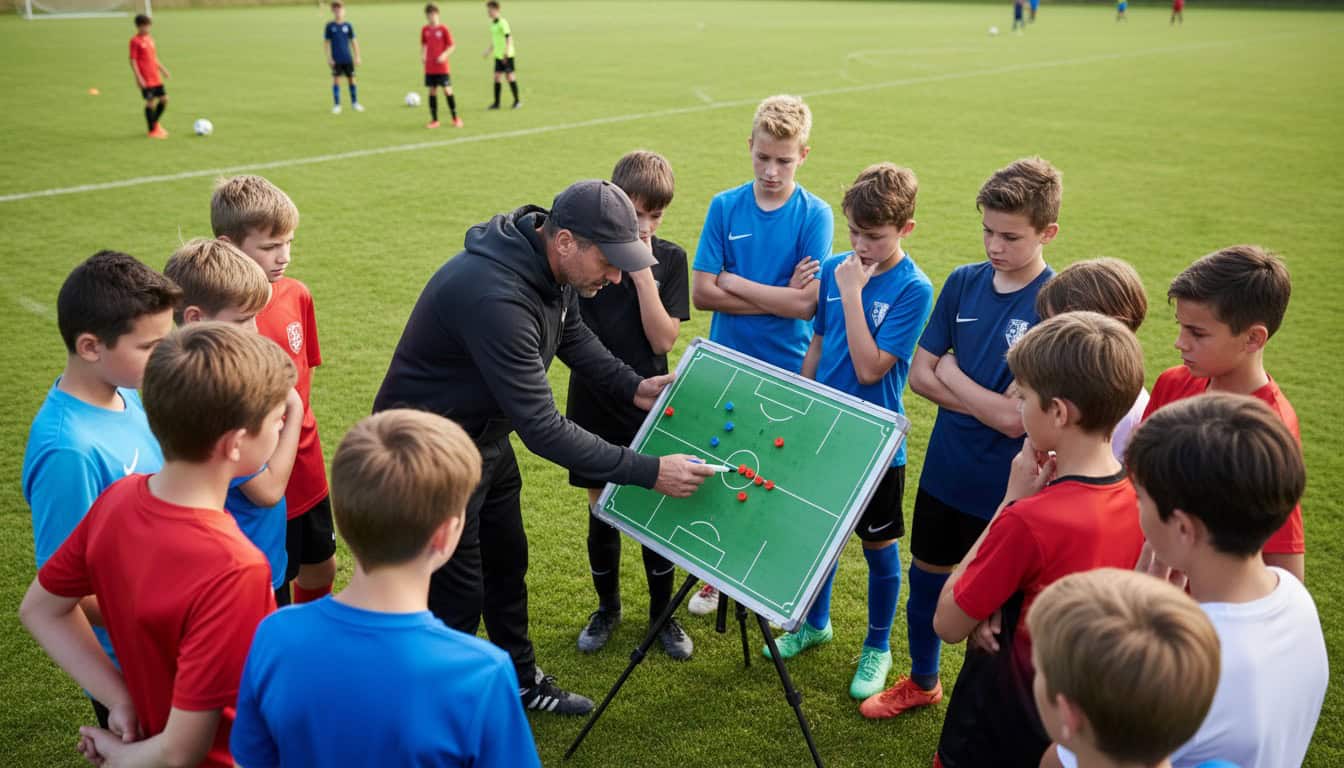
Use friendly matches for tactical experimentation by testing new formations, trying players in different positions, and practicing specific game scenarios without the pressure of league consequences—planning your experiments beforehand and gathering feedback afterward to maximize learning.
Key Takeaways
- Test formations: Try systems you can't risk in competitive matches
- Develop players: Experiment with positional changes and role variations
- Practice scenarios: Work on set pieces, pressing triggers, and build-up patterns
Why Friendlies Are Perfect for Tactical Testing
League matches demand results. Cup ties bring pressure. But friendlies? They create space to learn, experiment, and develop without the fear of dropping points or getting knocked out.
Smart managers use friendlies strategically to:
- Expand tactical options: Build a repertoire of formations and styles
- Discover player versatility: Find out who can play where
- Prepare for specific opponents: Practice approaches for upcoming competitive fixtures
- Develop game intelligence: Help players understand different tactical systems
- Test ideas before committing: Validate concepts in match conditions
A friendly match isn't just fitness work or squad bonding—it's a tactical laboratory.
What to Experiment With in Friendlies
Formation Testing
Use friendlies to explore formations outside your default system:
| If Your Default Is | Experiment With | What You'll Learn |
|---|---|---|
| 4-4-2 | 4-3-3 | Width creation, midfield control |
| 4-3-3 | 3-5-2 | Wing-back play, midfield overloads |
| 4-2-3-1 | 4-4-2 diamond | Central compactness, quick transitions |
| 3-5-2 | 4-4-2 | Defensive stability, wide balance |
Testing approach:
- Play one half in each formation, or
- Use the same formation throughout with variations on roles, or
- Switch at planned intervals (every 20 minutes)
Positional Experiments
Discover player versatility by trying:
| Position Change | What to Watch For |
|---|---|
| Full-back to winger | Attacking instincts, defensive recovery |
| Central midfielder to centre-back | Positioning, aerial ability, composure |
| Winger to striker | Movement in the box, link-up play |
| Striker to number 10 | Creativity, pressing from the front |
| Centre-back to holding midfielder | Passing range, reading of the game |
Communicate clearly with players beforehand. Frame it as development, not demotion.
Playing Style Variations
Test different approaches to the same situations:
Build-up play:
- Short passing from goalkeeper
- Long ball to target forward
- Playing through midfield thirds
- Switching play early vs building centrally
Pressing:
- High press from the front
- Mid-block with pressing triggers
- Low block and counter-attack
- Man-oriented vs ball-oriented defending
Attacking patterns:
- Overlapping full-backs
- Inverted wingers
- Direct play into channels
- Possession-based approach
Set pieces:
- Corner routines (short, near post, back post, zones)
- Free kick variations
- Throw-in patterns
- Defensive set-up changes
Planning Your Tactical Experiments
Before the Match
1. Identify what you want to learn
Choose 1-3 specific elements to focus on. Too many experiments blur the data.
Good examples:
- "How does our back four cope when we press high?"
- "Can Player X operate as an inverted winger?"
- "Does our new corner routine create chances?"
2. Brief your players
Explain what you're testing and why. Players perform better when they understand the purpose.
"Today we're trying a 3-5-2 in the first half. We want to see how we control midfield with the extra body. In the second half, we'll revert to 4-4-2 to compare. Be patient with mistakes—this is about learning, not winning."
3. Plan substitution timing
Structure subs to serve your experiments:
- Swap formations at specific intervals
- Compare different player combinations
- Give trialists or fringe players meaningful minutes in experimental roles
4. Assign observation roles
Have someone specifically watch for:
- How players adapt to unfamiliar positions
- Where space appears (or disappears) with formation changes
- Defensive vulnerabilities in new systems
- Attacking patterns that emerge
During the Match
Stay flexible but committed
Give each experiment enough time to generate useful data. Changing after 10 minutes because it's not working immediately defeats the purpose.
However, if player safety is at risk (major mismatch, injury danger), adjust accordingly.
Make mental or written notes
Capture observations in real-time:
- Moments where the experiment worked
- Situations where it broke down
- Player responses and body language
- Unexpected discoveries
Communicate adjustments
Use natural breaks to provide guidance:
- Half-time for significant tactical points
- Substitutions for individual feedback
- Dead ball situations for quick reminders
Ready to find matches?
Join verified teams finding friendly matches in minutes, not days.
Gathering Feedback After Tactical Experiments
Player Debrief
Ask players directly:
- "How did you find playing in that position?"
- "What felt different about that formation?"
- "When did you feel confident? When did you feel unsure?"
- "Would you be comfortable playing that role in a competitive match?"
Players often notice things coaches miss from the touchline.
Video Review (If Available)
Even smartphone footage helps identify:
- Spacing and shape maintenance
- Movement patterns and player positioning
- Moments of confusion or miscommunication
- Successful execution of planned patterns
Results vs Learning Balance
In tactical experiments, the scoreline matters less than answers to:
- Did we execute what we practiced?
- What needs refinement?
- Which players adapted well to new roles?
- Is this approach worth developing further?
A 3-0 loss while learning something valuable beats a scrappy 1-0 win where you learned nothing.
Structuring Friendlies for Maximum Learning
The Split-Half Approach
First half: Experiment with new concept
Second half: Return to familiar system
Compare performance, player comfort, and overall effectiveness.
The Progressive Build
Match 1: Introduce new formation
Match 2: Refine spacing and roles
Match 3: Add tactical triggers
Match 4: Test against strong opposition
Use a series of friendlies to develop a concept over time.
The Stress Test
Deliberately choose a challenging opponent to test:
- "Can our high press work against technically strong teams?"
- "Does our new formation hold up against physical opposition?"
- "How do players cope with the new system when under pressure?"
The Low-Stakes Environment
Against weaker opponents, you have space to:
- Make mistakes without punishment
- Try unusual combinations
- Give inexperienced players time in experimental setups
- Focus purely on execution rather than results
Common Tactical Experiments and What to Look For
Experiment: High Pressing
What to test: Triggers for pressing, pressing traps, recovery when bypassed
Watch for:
- Do players press as a unit or individually?
- How quickly do we recover when the press is broken?
- Are we winning the ball in dangerous areas?
- What's our fitness like maintaining high intensity?
Experiment: Three-at-the-Back
What to test: Central defender spacing, wing-back positioning, midfield balance
Watch for:
- Do centre-backs communicate well as a three?
- Are wing-backs positioned to attack and defend?
- Where do we get overloaded?
- How do we transition when we win the ball?
Experiment: Playing Out from the Back
What to test: Goalkeeper involvement, centre-back passing angles, pressing resistance
Watch for:
- Is the goalkeeper comfortable under pressure?
- Do midfielders find good receiving positions?
- When should we go long instead?
- How do opponents try to disrupt us?
Experiment: Inverted Full-Backs
What to test: Midfield overloads, width from elsewhere, defensive transitions
Watch for:
- Do full-backs time their movements into midfield?
- Are wingers providing width effectively?
- What happens when we lose possession centrally?
- How does this affect our build-up rhythm?
Communicating Experiments to Your Squad
Frame Experimentation Positively
Avoid saying: "We're going to try something different because what we're doing isn't working."
Instead say: "We're expanding our tactical options today. The more systems we're comfortable with, the more adaptable we become."
Manage Expectations
Be clear that:
- The result isn't the primary focus
- Mistakes are expected and accepted
- Every player should try to execute the plan, even if it feels unfamiliar
- Feedback will follow—this is a learning process
Involve Players in the Process
Senior players especially can contribute:
- What do they see from the pitch that you miss?
- What alternatives would they suggest?
- How does the experiment feel from their position?
Selecting Opponents for Tactical Testing
Consider Your Experiment Goals
| What You're Testing | Ideal Opponent |
|---|---|
| New formation basics | Similar or slightly lower level |
| Pressing system | Technically capable team |
| Defensive resilience | Attacking-focused opposition |
| Counter-attacking | Possession-dominant team |
| Set piece routines | Any willing opponent |
Communication with Opponents
Be honest when appropriate: "We're using this friendly to test some new ideas—you might see us try a few different setups. Looking for a competitive game but more focused on development than the result."
Good opponents appreciate transparency and may approach their own match similarly.
Documentation: Tracking Tactical Experiments
Create a simple log for each experiment:
Tactical Experiment Log Template
- Date: [Date]
- Opponent: [Team name]
- Experiment: [What you tested]
- Formation: [System used]
- Key roles: [Player assignments]
- Duration: [How long you tested]
- Worked well: [What succeeded]
- Needs work: [What struggled]
- Player feedback: [Key comments]
- Worth developing further: [Yes/No/Maybe]
- Next steps: [What to try next]
Over a season, this becomes valuable reference material for tactical development.
How This Relates to Match Organization
Tactical experimentation fits within your broader friendly match planning:
- Season Planning Guide: Plan experiment-focused fixtures into your season calendar
- Finding Opponents at Your Skill Level: Choose opponents appropriate for testing specific concepts
- Finding Opponents Complete Guide: Build a network that supports various testing needs
Frequently Asked Questions
How do I convince players to buy into tactical experiments?
Explain the development benefit clearly. Players who understand multiple systems become more valuable. Frame experiments as expanding their football education, not undermining their preferred way of playing.
What if the experiment is clearly failing during the match?
Give it at least 20-25 minutes before abandoning. Some discomfort is expected when trying new things. However, if player safety or team morale is seriously affected, adjust and debrief afterwards about what went wrong.
Should we tell the opponent what we're experimenting with?
Not necessarily the details, but being open about development focus is fine. It sets expectations appropriately and they may be more understanding of unusual substitution patterns.
How many experiments should we run in one friendly?
Focus on one main concept, perhaps with one or two smaller elements. Too many variables make it hard to draw useful conclusions.
Is it unfair to opponents if we're not playing our strongest approach?
No. Friendlies are for development by definition. Opponents benefit from competitive match time regardless of your tactical setup.
How do I balance experiments with giving players good match experience?
Some friendlies focus on tactical testing, others on building confidence and rhythm. Plan your friendly calendar to include both. Players should know which type each match is.
What if a player refuses to try a new position?
Have a private conversation to understand their concerns. Sometimes it's confidence, sometimes it's career planning. Respect boundaries but explain your reasoning.
Can academy teams use the same experimental approach?
Development environments should feature even more experimentation. Academy players benefit enormously from positional versatility and tactical understanding.
How do we measure success in tactical experiments?
Define success criteria before the match. "We successfully built out from the back 70% of the time" is measurable. "It felt better" is not.
Should tactical experiments happen more in preseason or throughout the year?
Preseason offers more freedom, but in-season friendlies provide opportunities to test against specific upcoming opponents. Spread experiments throughout the year.
Ready to find your next match?
Join verified teams finding opponents in minutes.
Create your free accountNo credit card required