Quick Answer
Assess youth player skill levels by observing technical ability, game understanding, physical attributes, and attitude across multiple sessions—then use this assessment to place players in appropriate recreational or competitive pathways that match their current level and ambitions.
- ✓Observe holistically — Technical skills, game sense, physical development, and attitude all matter
- ✓Use multiple sessions — One observation isn't enough for accurate assessment
- ✓Match pathways to players — Different players need different environments to thrive
Why Skill Level Assessment Matters
Not every young player has the same ability, ambition, or developmental timeline. Placing players in the right environment helps them:
- Enjoy football: Appropriate challenge keeps engagement high
- Develop effectively: The right level of competition supports growth
- Build confidence: Success at the right level builds self-belief
- Stay in the game: Players who fit their environment are more likely to continue
Assessment isn't about labeling children as "good" or "bad"—it's about finding the best environment for each player's current stage.
Recreational vs Competitive: Understanding the Difference
Recreational Football
Focus: Participation, enjoyment, social connection
All players get equal playing time, results matter less than experience, and fun is the priority. Suits players who are new to football, play for social reasons, have other commitments, prefer lower pressure, or are still developing foundationally.
Competitive Football
Focus: Development, performance, progression
Playing time may vary based on development and match context, results matter alongside development, and higher standards are expected. Suits players who show higher ability, are motivated to improve, can commit to greater demands, and have ambitions for higher-level football.
What to Assess
Technical Skills
- Ball control: First touch quality, ability to receive under pressure, control with both feet
- Passing: Accuracy over short and longer distances, appropriate weight of pass
- Dribbling: Close control in tight spaces, ability to beat opponents
- Shooting: Technique, accuracy, composure in front of goal
Game Understanding
- Decision-making: Choosing the right option, speed of thought
- Positioning: Understanding of space, movement off the ball
- Game reading: Anticipating play, recognizing patterns
Physical Attributes
- Speed and agility: Pace over short distances, change of direction
- Strength and balance: Ability to hold off opponents, core stability
- Endurance: Ability to maintain effort, consistency across match duration
Note: Physical attributes should be contextualized by developmental stage. Early physical maturity doesn't indicate long-term potential.
Attitude and Character
- Coachability: Listens and responds to feedback, willing to try new things
- Work ethic: Effort in training, consistency of application
- Resilience: Response to setbacks, coping with pressure
- Team orientation: Supports teammates, communicates positively
Assessment Methods
Observation During Training
Watch players across multiple sessions, looking for:
| Aspect | What to Look For |
|---|---|
| Technical execution | Clean, consistent technique |
| Decision-making | Right choices under pressure |
| Effort | Consistent work rate |
| Interaction | How they relate to others |
| Response to coaching | Uptake of instruction |
Observation During Matches
Game situations reveal performance under pressure, application of skills in competition, decision-making in real-time, and competitive mentality.
Structured Assessment Activities
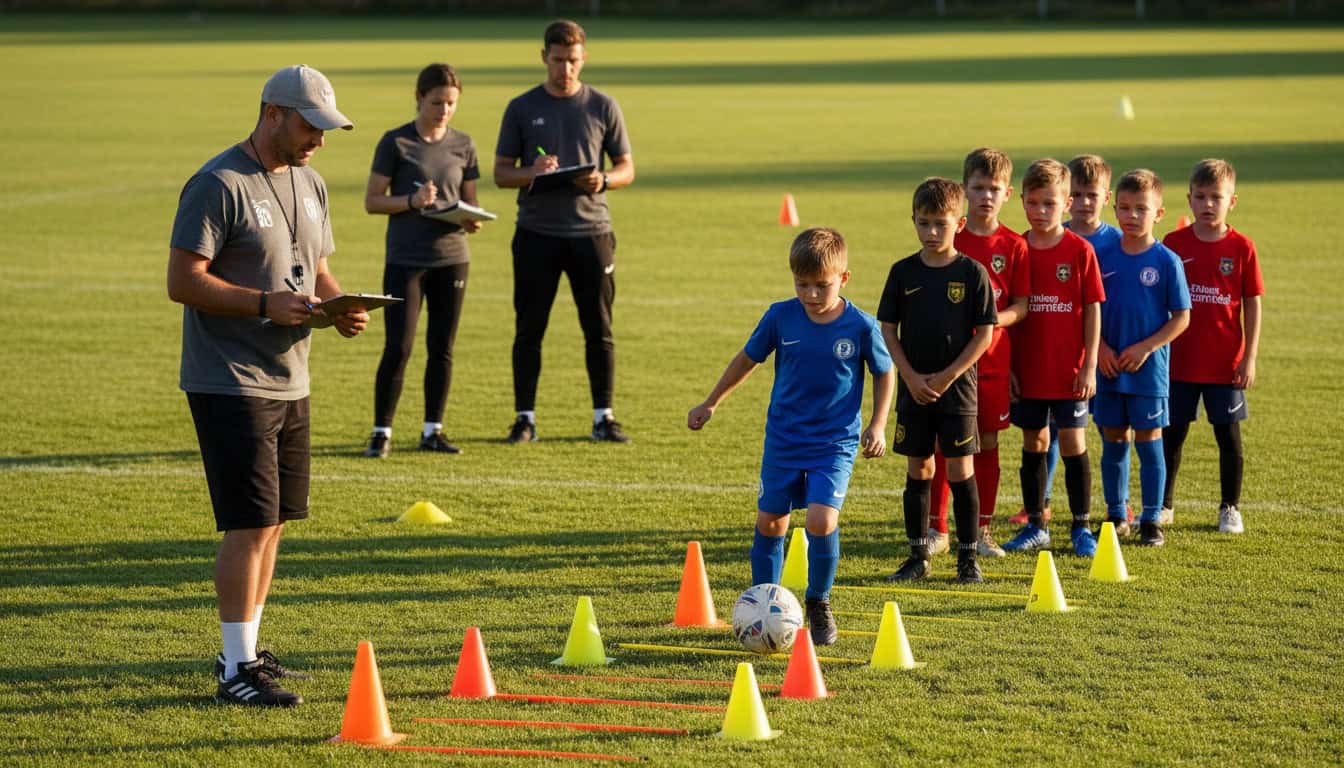
Technical circuit: Dribbling through cones, passing to targets, shooting at goal, ball control challenges.
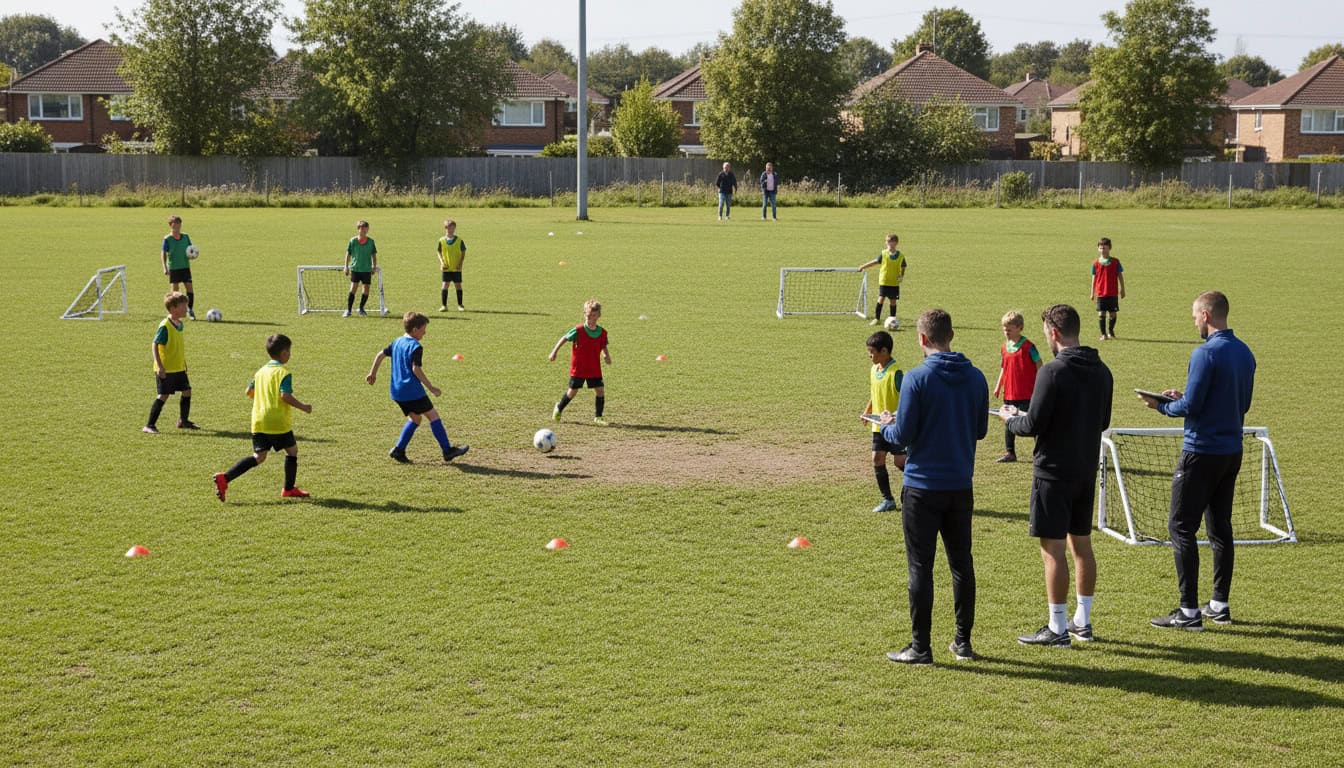
Small-sided games: 3v3 or 4v4 reveals decision-making. Observe with and without ball, noting problem-solving ability.
Creating Assessment Criteria
Sample Assessment Framework
Rate players 1-5 on key attributes:
| Attribute | 1 (Developing) | 3 (Competent) | 5 (Advanced) |
|---|---|---|---|
| Ball control | Inconsistent, loses ball often | Generally secure | Excellent touch |
| Passing | Inaccurate, limited range | Accurate short distance | Varied, accurate |
| Game understanding | Limited awareness | Understands basics | Reads game well |
| Work ethic | Inconsistent effort | Good effort mostly | Consistently high |
| Coachability | Struggles with feedback | Responds to instruction | Actively seeks improvement |
Important: Use assessment as a guide, not an absolute. Context, attitude, and potential matter alongside current ability.

Making Placement Decisions
Factors Beyond Current Ability
Consider player ambition (what do they want from football?), family commitment (can they meet pathway demands?), developmental trajectory (are they improving rapidly?), late developer potential, and enjoyment (will they thrive in this environment?).
Having the Conversation
Be honest but kind: "Based on what we've seen, we think [player] would develop well in our development squad."
Focus on the positive: "We've seen some real strengths in [areas]. This program will give them the chance to build confidence."
Keep doors open: "This isn't a permanent decision. We review placement regularly."
Regular Reassessment
When to Review
- Formally: Start of each season or term
- Informally: Ongoing observation throughout
- Triggered: When significant change is observed
Movement Between Pathways
Moving to more competitive: Sustained improvement, increased commitment, demonstrated ability to handle higher demands.
Moving to less competitive: Struggling to cope with demands, loss of enjoyment, changed circumstances, player or family request.
Handle movement sensitively—neither direction is "better" or "worse."
Avoiding Common Mistakes
Early Streaming Risks
- Don't stream too young: Before U12, differences often reflect physical maturity, not potential
- Don't over-rely on current ability: Potential matters. The best U9 isn't necessarily the best U16
- Don't let parents drive decisions: Assess players objectively
Bias Awareness
Watch for bias based on physical size (not indicative of potential), confidence (quiet players can be excellent), parents (parental involvement doesn't equal player ability), and first impressions (some players take time to show ability).